
Quinn Hughes · 28 September 2026
Adaptive Geometry Algorithms Enhancing Precision in Bespoke Manufacturing Processes for Scalable Component Systems
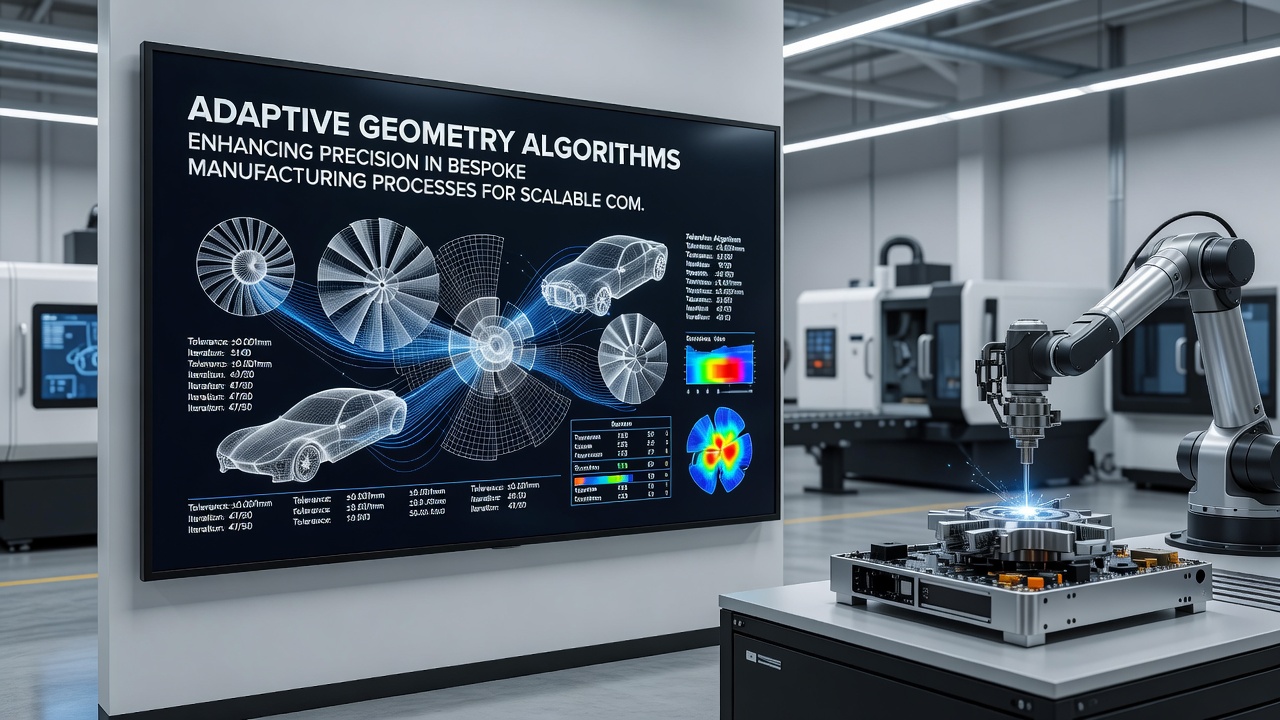
Adaptive geometry algorithms adjust computational models of shapes and surfaces during production cycles, allowing manufacturers to refine tolerances without halting entire assembly lines, while data from sensors feeds back into the system to correct deviations in real time. These methods build on established parametric design principles yet incorporate machine learning layers that predict material behavior under varying loads and temperatures, which helps maintain consistency across batches of custom parts destined for larger modular frameworks.
Core Mechanisms in Custom Fabrication
Researchers at institutions focused on industrial computation have documented how adaptive meshing techniques subdivide surfaces into smaller elements that resize dynamically based on curvature and stress concentrations, and this approach reduces over-processing in areas where geometry remains stable while concentrating computational resources where precision matters most. In bespoke manufacturing environments, operators integrate these algorithms with CNC controllers so that tool paths update mid-operation when incoming measurements indicate a slight warp or thermal expansion in the workpiece.
Systems deployed in aerospace component shops, for example, combine laser scanning with adaptive geometry routines to generate updated surface definitions on the fly, and the resulting toolpaths achieve positional accuracy within microns even when starting from organic or freeform base models supplied by clients. Data compiled by the National Institute of Standards and Technology shows measurable reductions in scrap rates when such feedback loops operate continuously rather than at fixed inspection intervals.
Integration with Scalable Component Systems
Scalable component systems rely on interchangeable modules that must interface precisely despite originating from separate production runs or suppliers, and adaptive geometry algorithms support this requirement by maintaining a shared digital twin that evolves as each new part is completed. When a module designed for one configuration must later serve in an expanded assembly, the algorithm recalculates mating surfaces and tolerance stacks without requiring a full redesign of the original files.
Manufacturers in the automotive and renewable energy sectors have adopted these workflows to produce families of brackets, housings, and structural nodes that share core geometries yet accommodate site-specific modifications, while the underlying code ensures that dimensional drift remains below thresholds set by international standards. In September 2026, updates to ISO 2768 and related tolerance guidelines are scheduled to reference adaptive computational methods explicitly, reflecting the growing acceptance of these techniques across regulated industries.
Precision Outcomes and Process Efficiency
Precision gains appear most clearly in applications involving curved or compound surfaces where traditional fixed-geometry CAM software leaves excess material or requires multiple manual interventions, yet adaptive routines detect these regions early and redistribute machining passes accordingly. Case documentation from facilities in Canada and Australia indicates that cycle times for complex bespoke housings have dropped by double-digit percentages after implementation, primarily because rework loops shrink when the algorithm compensates for real-world material response during cutting.
Those who have studied the integration of these tools note that the largest efficiency improvements occur when the same algorithmic framework serves both one-off prototypes and subsequent scaled production of identical modules, since learned parameters transfer directly between jobs without recalibration from scratch. Government-funded research programs in the European Union have funded pilot lines that demonstrate how adaptive geometry supports traceability requirements under the upcoming Digital Product Passport framework, linking each physical part to its evolving geometric record.
Implementation Considerations Across Sectors
Adoption requires coordination between software vendors, machine tool builders, and quality assurance teams, and several industry consortia now publish open reference datasets that allow smaller fabricators to test adaptive routines on their existing equipment. Training programs at technical universities emphasize the importance of maintaining version control over both the geometric models and the adaptation rules themselves, since changes to either can propagate through an entire family of scalable components.
Observers tracking adoption patterns report that companies begin with non-critical parts to validate the feedback mechanisms before applying the technology to load-bearing or safety-critical modules, and this staged rollout reduces risk while building institutional familiarity with the updated workflows. Figures from academic studies in computational manufacturing indicate that the computational overhead of running adaptive algorithms remains modest on modern multi-core controllers, particularly when selective refinement limits the number of elements updated per cycle.
Conclusion
Adaptive geometry algorithms continue to reshape how bespoke manufacturing supports scalable component systems by embedding real-time correction into production sequences that once relied on post-process inspection alone. As sensor networks, control hardware, and regulatory expectations evolve in tandem, the documented precision improvements and efficiency gains provide a measurable foundation for wider deployment across multiple industrial domains.